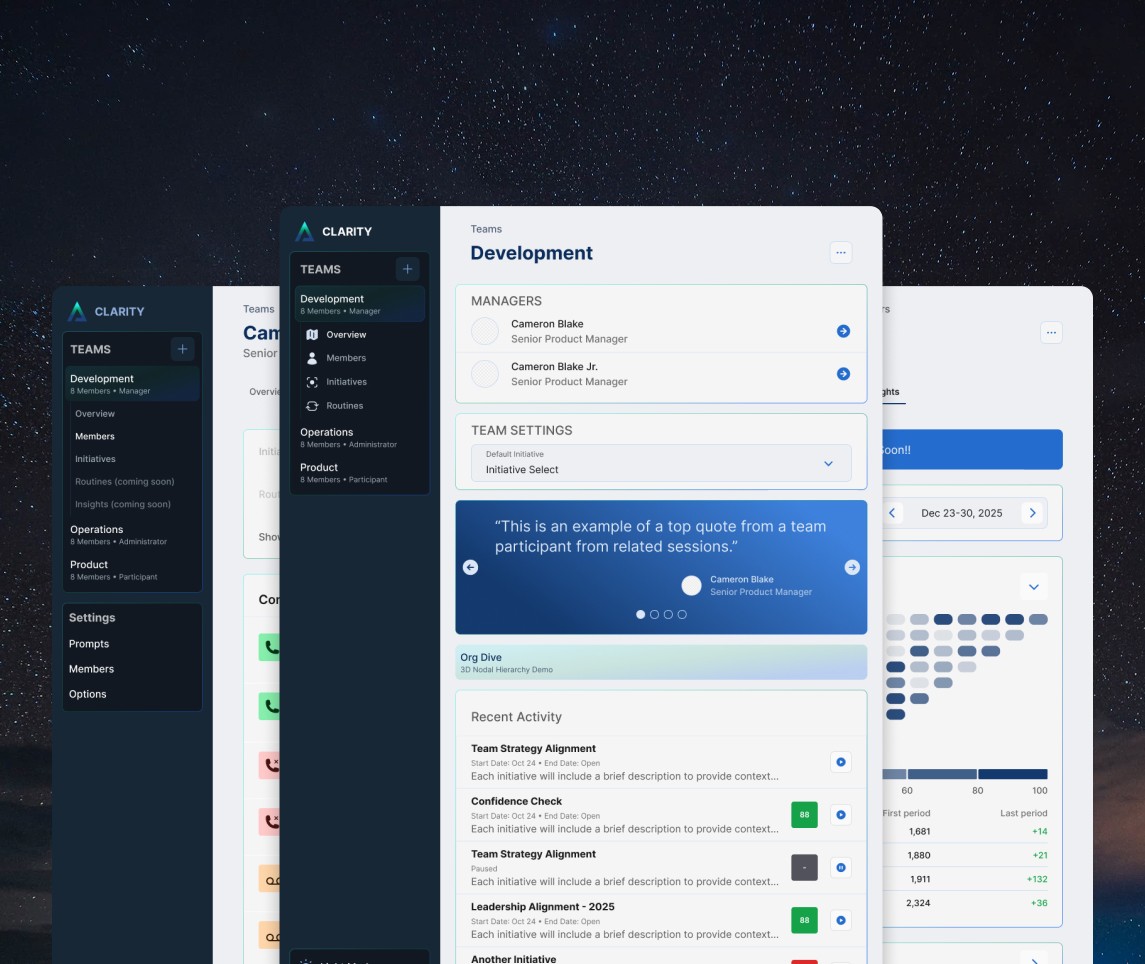
Project Background
Clarity is a conversational AI platform used by enterprise managers and distributed field teams to capture weekly voice-based insights, aggregate team sentiment, and surface patterns that traditional 1-on-1s and surveys routinely miss.
Product Name: Clarity
Role: Lead Product Designer & UX Strategist
Team:
Brett Howell (Founder)
James Bodajlo (Founder)
Juan Jaramillo (Technical Lead)
Callan Brimhall (Frontend Engineering)
Ethan Luts (Backend Engineering)
Pepe Sifontes (Product Advisor & Strategy Support)
Frank Urso (Executive Advisor & Product Review)
Platforms:
Desktop Web: Primary platform for managers reviewing trends and aggregated insights.
Mobile (SMS & Phone Calls): Primary channel for participant engagement, enabling frictionless voice check-ins without apps or logins.
Tools: Figma, Miro, Trello, Figjam, Slack, Zoom, Canva, Photoshop, Retool
My Responsibilities
Lead Product Designer for AI platform
Cross-functional stakeholder engagement
Translate vision into roadmap and flows
Facilitate standups, WIPs, and reviews
Manage timelines, scope, and priorities
Coordinate with engineering leads
Maintain design system and tokens
Present work to executives and partners
Create demo narratives and scripts
Support partner-led go-to-market
UX Responsibilities | UI Responsibilities |
|---|---|
|
|
The Concept
The team started with lessons learned from our work at 4th Down Solutions, where we spent more than a decade helping organizations strengthen performance and alignment. We learned firsthand how hard it is to get reliable insight from teams, what methods failed under real pressure, and which approaches actually unlocked honest, usable signals.
We landed upon a core goal we wanted to address. Build a simple way for teams to share honest context without adding extra work. We set out to create a lightweight voice check in that captured real signals and translated them into meaningful team awareness.
User Context & Pain Points
Through 181 hours of stakeholder interviews and pilot observations (May 2020 - March 2025), we identified a consistent pain point across enterprise managers:
Primary users — Mid-level managers (5-10 person teams) in distributed organizations:
Spent 8 hours/week on 1-on-1s that felt repetitive ("How are you? How's the project?")
Couldn't physically reach entire team before critical decisions (time zones, distributed work)
Had individual insights but no team-level patterns or trends
Operated reactively (firefighting) rather than proactively (pattern recognition)
Quarterly reviews required scrambling through Slack/email to remember accomplishments
Secondary pain — Field leaders managing 20-30 geographically distributed direct reports struggled to gather pre-event input, capture post-event feedback, or maintain connection between formal reviews.
The Core Problem
Managers need organizational intelligence at scale, but existing solutions either:
Add administrative overhead (surveys = more work)
Provide individual data without synthesis (1-on-1 notes scattered)
Require users to come to the tool (adoption failure)
Generate abstract metrics without actionable context ("engagement score = 6.7" — so what?)
Key Constraint: Any solution requiring managers to "do more work" would fail. The tool must be invisible to end users and generative for managers.
Critical Assumption: Voice conversations could extract richer insights than text surveys while requiring less user effort (answer phone vs fill out form).
How Might We...
How might we help managers understand team health and engagement proactively, without adding administrative burden to themselves or their teams—and surface insights that enable human decision-making rather than prescribing actions?
The Solution
Clarity introduces a new model: ambient voice check-ins powered by AI. Employees speak freely — sharing what’s going well, what’s unclear, or what’s getting in the way. The system transcribes, analyzes, and synthesizes responses into visual summaries and trend insights. Leaders gain a clearer picture of their teams — not just tasks, but tone.
Research and Insights
We conducted qualitative research across five enterprise teams, including:
Stakeholder interviews with HR, product, and team leads.
Voice diaries and feedback logs from pilot users.
Shadowed stand-ups and retros to understand real-world team dynamics.
Key findings
Finding 1: "Give us the PowerPoint"
Leaders need more than data - they need patterns, stories, and early warnings. Individual conversation summaries were valued, but managers explicitly requested team-level aggregation. "Can you give me the PowerPoint? I need the one-pager that shows what my entire team is thinking." This wasn't about individual reports—it was about organizational patterns invisible at the 1-on-1 level.
Finding 2: Voice > Text (but quality is existential)
Employees prefer speaking over typing - it’s faster, more expressive, and feels more personal. Users preferred 5-minute phone calls over 15-minute surveys. Natural conversation captured nuance, tone, hesitation. Additionally, trust and psychological safety are essential - users want clarity on how insights are shared and used.
Finding 3: The product's value compounds over time
One conversation = interesting. Four weeks of trends = pattern recognition. Longitudinal insights (sentiment declining, engagement dropping) enable proactive intervention before crisis.
Finding 4: Enterprise buyers expect desktop, not mobile
Team built mobile-first dark mode aesthetic (our preference). Customers repeatedly rejected demos as "unpolished" or "unprofessional" for stakeholders. Hard pivot to desktop-first light mode required. Learning: Our aesthetic assumptions ≠ customer buying preferences.
Design Process
Our design process combined systems thinking with emotional intelligence:
Ideation & Flow Mapping - Structured around contributor and consumer roles
Rapid Wireframes - Mapping out conversation flows, prompts, and summary views
Voice Prototypes - Testing interaction models with real scripts and recorded input
Visual Design - A calm, neutral interface using optical and auditory metaphors
User Testing & Iteration - Conducted weekly sessions with test teams, refining tone and flow
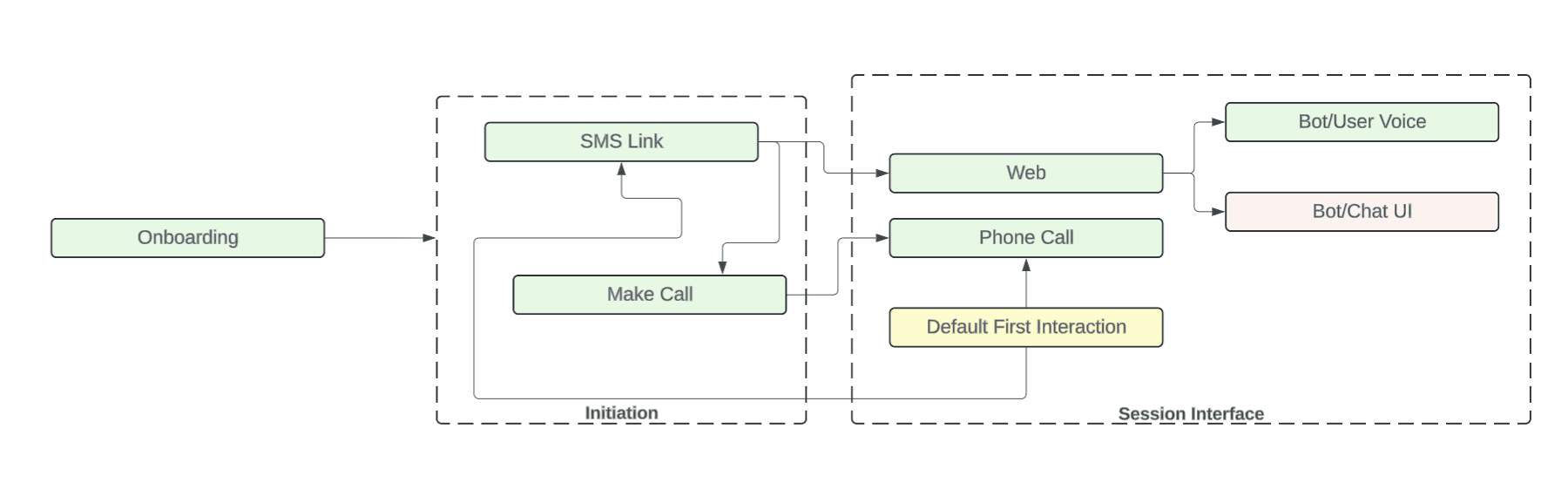
Final Designs - The Clarity platform includes:
Voice Experience: A configurable, adaptable voice agent designed to deliver engaging conversations that adapt to participant communication style.
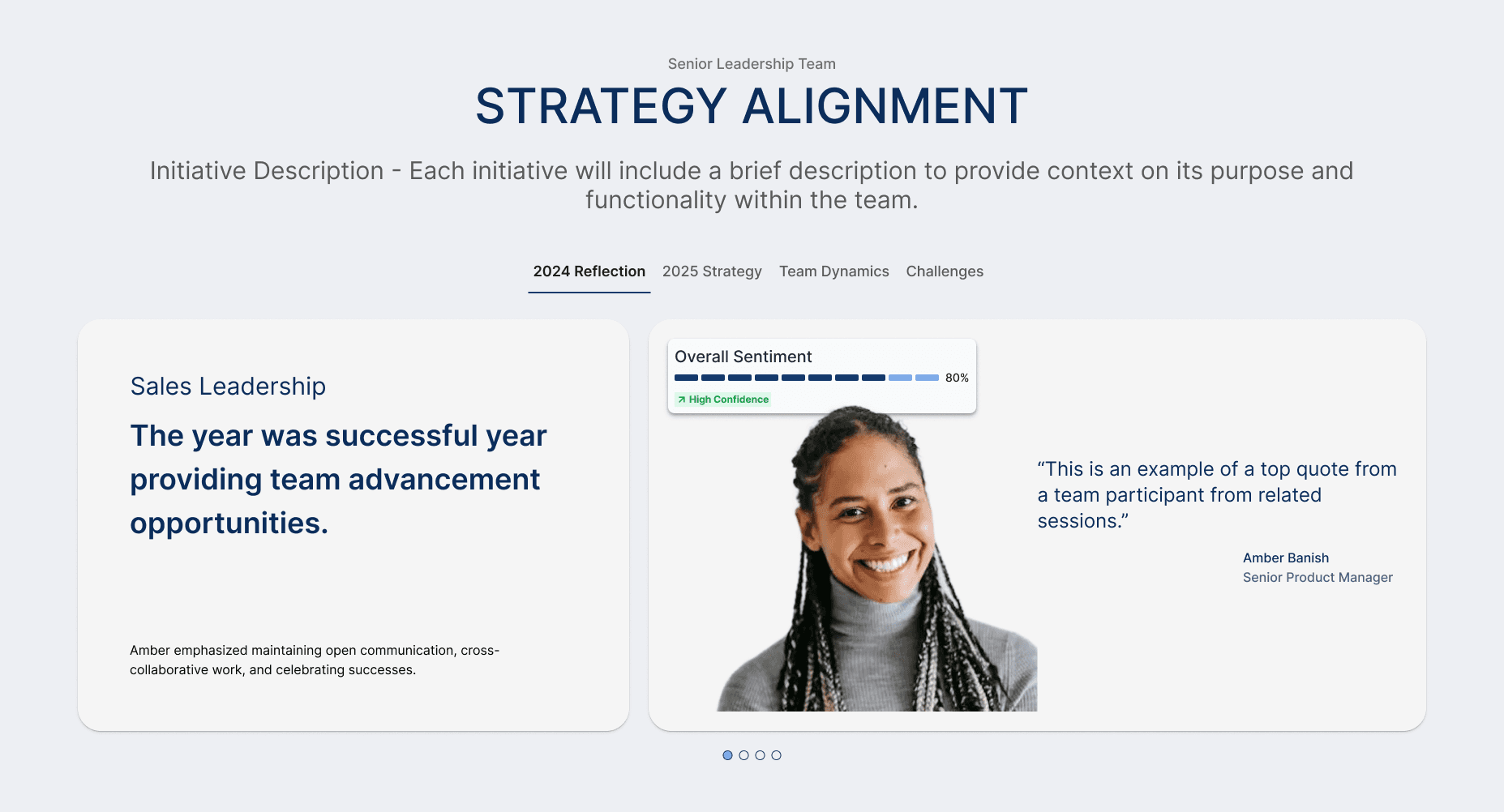
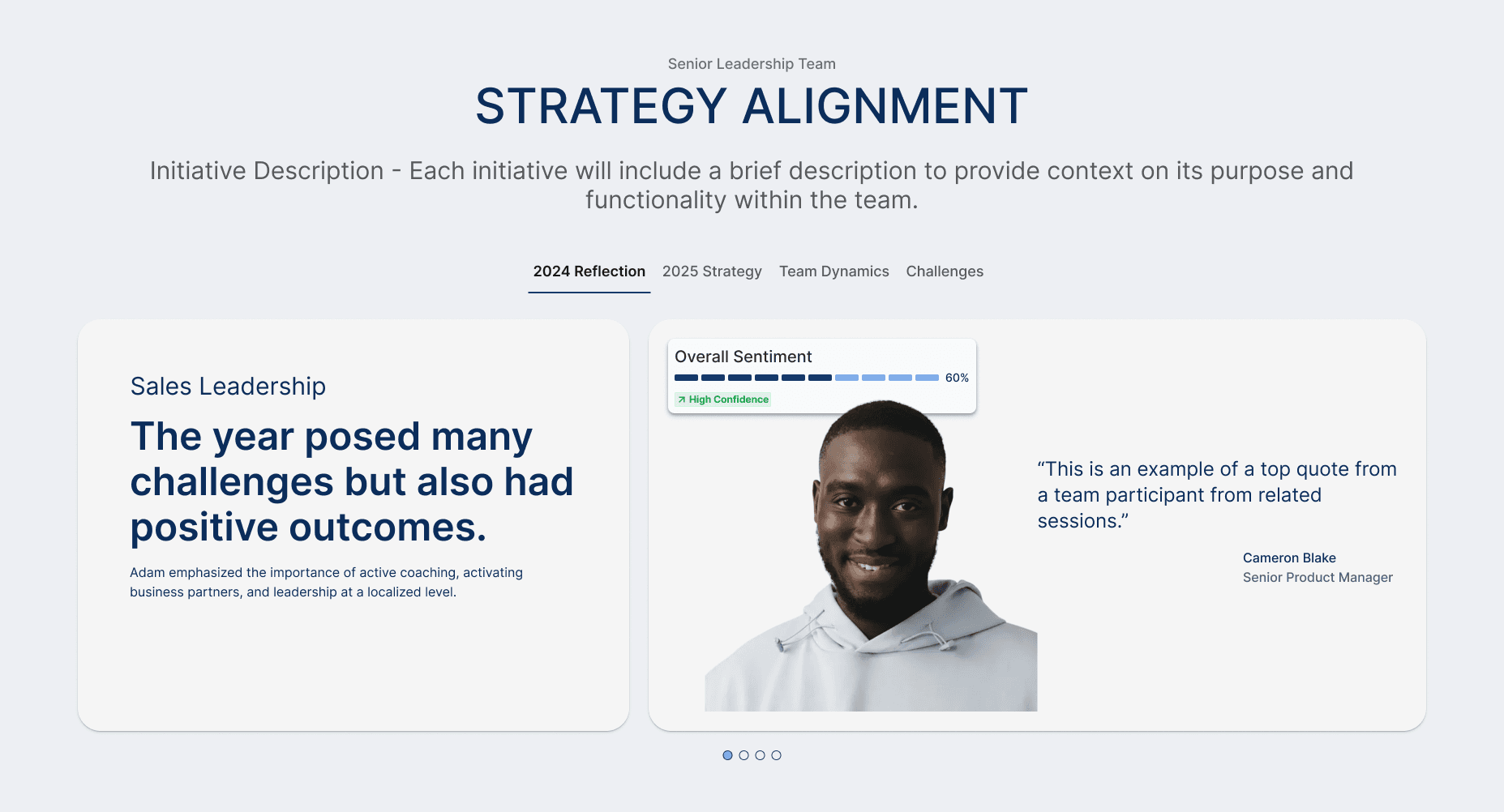
Insight Experience: A collection of adaptable output summaries made up of a mix of narratives, action items, and metrics. Able to deliver alternate outputs optimized for different team roles.
Organization Intelligence: Group teams into organizational hierarchies that deliver insights across company siloes.
Manager Tools: User interfaces to configure teams, initiatives, and routines. Easy navigation of Insights with graph connections to major entities.
Reflection
Clarity challenged us to rethink how organizations listen — not just at scale, but with empathy and nuance. Designing for voice meant balancing openness with structure, and building trust into every interaction. We had to go beyond simply capturing feedback to creating a system that interprets tone, flags uncertainty, and respects user intent.
One of the biggest lessons was that insight alone isn’t enough. Leaders need context, contrast, and continuity — the ability to see not just what’s being said, but how things are shifting over time. We found that even small design decisions — like how summaries are framed, or how language is softened — had a measurable impact on user trust and willingness to share.
This project reinforced the importance of blending qualitative depth with system-level thinking. It also reminded us that the best tools don’t replace human judgment — they amplify it.